How Marketers Measure Traffic Quality, Leads, and Conversions
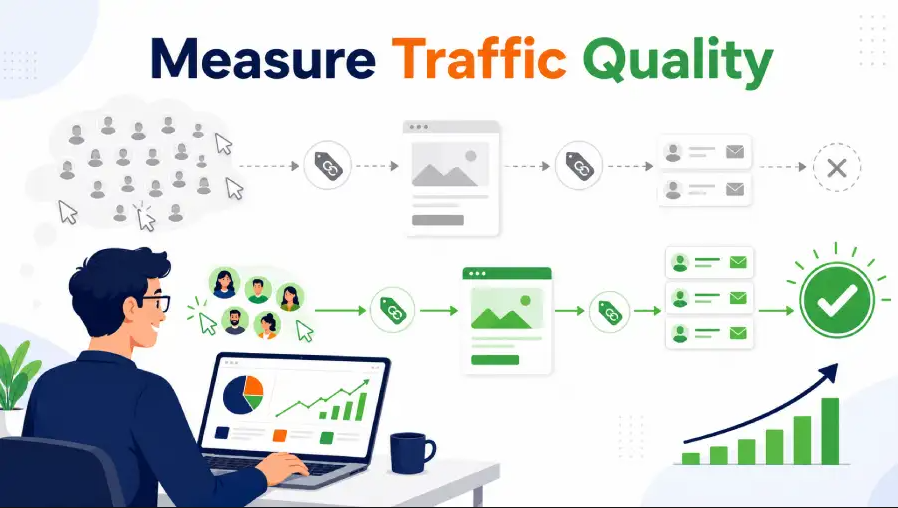
Marketing campaigns can generate thousands of clicks and still fail to produce meaningful business results.
This is because raw traffic numbers do not tell the whole story. A visitor may click an ad, open a landing page, and leave immediately. Another visitor may join an email list, open several emails, and become a customer weeks later.
To make better decisions, marketers need to measure traffic quality, leads, and conversions—not just visitor volume.
This guide explains the key metrics that help businesses understand whether a campaign is actually working.
What Is Traffic Quality?
Traffic quality describes how relevant and valuable website visitors are to a business goal.
High-quality traffic usually comes from people who are interested in the offer and are likely to take the intended next step. That action could be joining an email list, requesting a quote, buying a product, booking a call, or starting a free trial.
Low-quality traffic may still create clicks, but it often shows little engagement and few conversions.
For example, a website may receive 5,000 visitors from a broad promotion but generate only 10 email subscribers. Another campaign may bring 500 visitors and generate 80 subscribers. The second campaign has lower traffic volume but higher quality.
Why Clicks Are Not Enough
Clicks are useful because they show whether a link, ad, email, or social post attracted attention. However, clicks alone cannot show whether the visitor was relevant.
A click may come from:
- A genuinely interested prospect
- Someone who clicked by mistake
- A visitor curious about the headline but not the offer
- A bot or automated system
- A person outside the target market
- Someone looking for free information only
This is why marketers should measure what happens after the click.
The most useful question is not, “How many people visited?” It is, “What did the right visitors do after arriving?”
The Core Metrics Marketers Should Track
1. Click-Through Rate
Click-through rate, often called CTR, measures how many people clicked after seeing a link, ad, or email.
The formula is:
CTR = Clicks ÷ Impressions × 100
For example, if 100 people see an email and 10 click the link, the click-through rate is 10%.
CTR helps marketers understand whether a message, subject line, call to action, or advertisement is interesting enough to encourage action.
A low CTR may indicate that the offer is unclear, the audience is not relevant, or the headline needs improvement.
2. Landing-Page Conversion Rate
A landing-page conversion rate shows the percentage of visitors who complete the intended action.
The formula is:
Conversion Rate = Conversions ÷ Visitors × 100
If 200 visitors arrive on a landing page and 20 subscribe to an email list, the conversion rate is 10%.
This is one of the most important metrics because it connects traffic to a real outcome.
A campaign with a strong click-through rate but a weak landing-page conversion rate may have a problem with the page itself. The message in the ad may not match the page, the offer may be unclear, or the form may be too complicated.
3. Cost Per Lead
Cost per lead, or CPL, measures how much a marketer spends to generate one lead.
The formula is:
Cost Per Lead = Total Campaign Cost ÷ Number of Leads
If a campaign costs $100 and generates 25 email subscribers, the cost per lead is $4.
Cost per lead helps businesses compare traffic sources. However, the cheapest lead is not always the best lead. A $2 lead that never opens an email may be less valuable than an $8 lead that later becomes a customer.
4. Engagement Metrics
Engagement metrics show whether visitors interact with the page or content after clicking.
Useful engagement signals include:
- Time spent on page
- Pages viewed per session
- Scroll depth
- Video plays
- Button clicks
- Form-start rate
- Returning visitors
These metrics do not prove that a campaign will generate sales, but they can reveal whether visitors are interested.
For example, if most visitors leave a page within a few seconds, there may be a mismatch between the traffic source and the landing-page message.
5. Email Engagement
For campaigns focused on list building, email engagement is essential.
Track:
- Email open rate
- Email click-through rate
- Replies
- Unsubscribe rate
- Sales or enquiries generated from email
A healthy email list is not simply a large list. It is a list of people who are interested in the topic, open messages, and take action over time.
Use UTM Parameters to Identify Traffic Sources
UTM parameters are short tags added to a URL. They help analytics tools identify where visitors came from.
For example, a campaign link may include:
- utm_source
- utm_medium
- utm_campaign
This allows marketers to compare traffic from a newsletter, a social-media ad, a guest post, or an email-based campaign.
Google explains how campaign URL parameters can help identify a campaign’s source, medium, and name.
Without tracking links, marketers may know they received new visitors but not know which campaign produced them.
Why Traffic Quality Matters More Than Raw Clicks
A campaign should be judged by the value it creates—not by the largest number on a dashboard.
High-quality traffic is more likely to:
- Match the target audience
- Stay on the page longer
- Subscribe to an email list
- Engage with follow-up emails
- Return to the website
- Buy or enquire later
Marketers using email-based campaigns, including solo ads for affiliate marketing, should evaluate traffic by opt-ins, engagement, and conversions—not clicks alone.
Before launching a campaign, define the expected outcome. For example, a marketer may decide that success means a certain number of qualified email subscribers at a manageable cost per lead.
This creates a clearer standard than simply hoping for more traffic.
How to Spot Low-Quality Traffic
Low-quality traffic often has patterns that suggest visitors are not relevant or not real.
Warning signs can include:
- Very high clicks with almost no leads
- Extremely short visit duration
- High bounce rate
- Unusual traffic spikes with no engagement
- Repeated visits from the same technical patterns
- Visitors from locations outside the target market
- Many form submissions with fake or invalid email addresses
- No email opens after a large subscriber increase
One warning sign alone does not prove a problem. But several signals together should encourage the marketer to investigate.
Always review the source of traffic, the audience targeting, landing-page experience, and tracking setup before spending more.
Improve a Campaign One Step at a Time
When a campaign underperforms, avoid changing everything at once. Test one improvement at a time.
You could test:
- A different headline
- A shorter sign-up form
- A clearer call-to-action button
- A more specific lead magnet
- A different traffic source
- A different audience segment
- A faster-loading landing page
- A new email subject line
For example, if visitors click but do not subscribe, test the landing-page headline or lead magnet first. If subscribers join but do not engage with emails, improve the welcome sequence and content relevance.
Small, measured tests provide more useful data than large, untracked spending.
Create a Simple Campaign Reporting Dashboard
A basic report can help marketers make better decisions. Include the following information for every traffic source:
| Metric | Why it matters |
| Visitors | Shows campaign reach |
| Click-through rate | Measures initial interest |
| Leads | Shows completed sign-ups or enquiries |
| Conversion rate | Shows landing-page effectiveness |
| Cost per lead | Helps compare campaign efficiency |
| Email engagement | Indicates lead quality |
| Sales or revenue | Connects marketing to business results |
Reviewing these numbers regularly helps marketers see trends and avoid relying on assumptions.
Final Thoughts
Traffic is valuable only when it supports a clear business goal.
Clicks can show attention. Leads can show interest. Conversions can show real progress. By tracking all three, marketers can identify which channels bring the right visitors and which campaigns need improvement.
The goal is not to buy the most traffic. It is to create a reliable system that brings relevant visitors to a useful offer, measures their actions, and improves over time.
Frequently Asked Questions
What is traffic quality in digital marketing?
Traffic quality measures how relevant and valuable website visitors are to a business goal. High-quality visitors are more likely to engage with content, join an email list, request information, make a purchase, or take another intended action.
What metrics should marketers track besides clicks?
Marketers should track landing-page conversion rate, cost per lead, engagement metrics, email open and click rates, qualified leads, sales, and revenue. These metrics show what visitors do after clicking.
How do UTM parameters help marketers?
UTM parameters are tags added to campaign URLs that show where a visitor came from. They help marketers compare sources such as social ads, newsletters, guest posts, search campaigns, and email promotions.
How can marketers identify low-quality traffic?
Warning signs include many clicks with very few leads, very short visits, low engagement, invalid form submissions, visitors outside the target market, and no email activity after a large number of sign-ups.
One thought on “How Marketers Measure Traffic Quality, Leads, and Conversions”